🏀 When the Plug Becomes the Problem
|
Exploring basketball's best ideas, strategies, and coaches around the world Happy Sunday! Welcome to all the newest members from around the world! ICYMI: Last week, we looked at Bilbao’s use of the high slot pitch into a step-up screen, a familiar two-man game moved into a more difficult location for the defense. Read the newsletter HERE. This Week at a Glance:🔒 SG Plus Content: Reject the Hedge & Gortat - Attacking "Hedge & Plug" 🎧 Slappin' Glass Podcast: Mihai Silvășan on Practice Intensity, Risk/Reward Tradeoffs, and The Art of Motivation {Cluj-Napoca} 🔒 The Practice Lab: Variable Shooting 🥇 Best of the Week: Cross Screens & 5 Out Delay Hedge Reject & GortatThere are very few things we enjoy more at Slappin’ Glass than studying the constant back-and-forth chess match between offensive and defensive problem solving. A coverage rises. Offenses adapt. Defenses counter again. And the cycle continues.
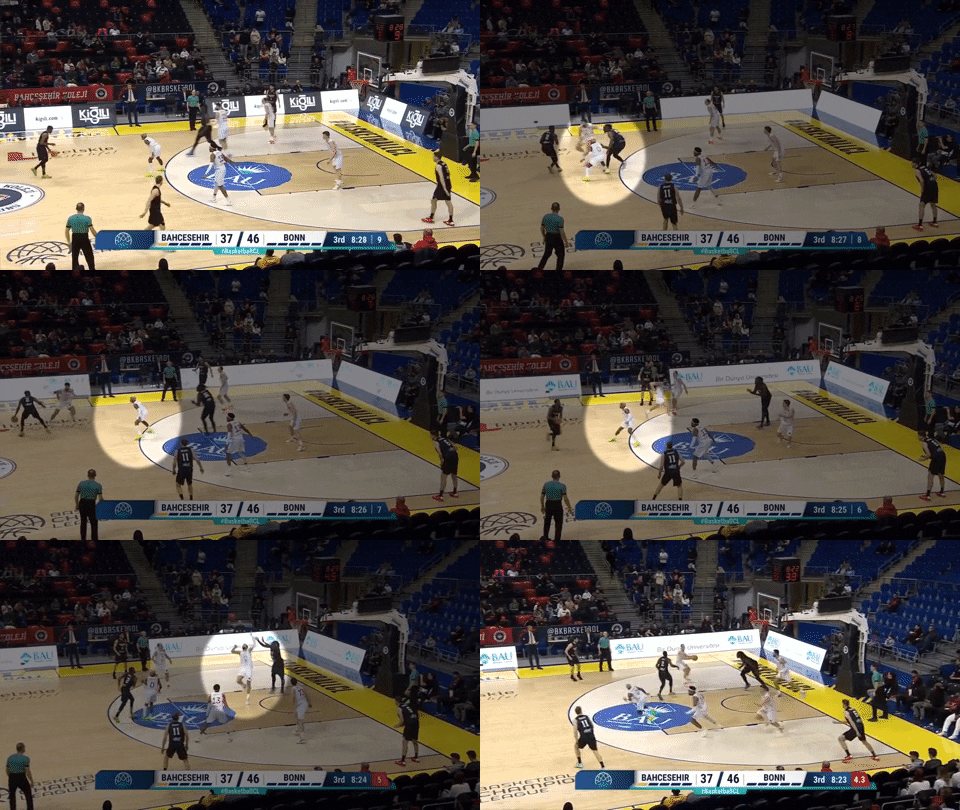
This week’s breakdown looks at an offensive adjustment against one of the more prominent ballscreen coverages of the last few seasons: Hedge and Plug {🔒}. We’ve covered Hedge and Plug extensively inside SG+, as the effectiveness of the tactic has led to widespread adoption around the world. The coverage combines a hard show from the screener’s defender with an under from the on-ball defender, allowing teams to stay aggressive at the point of the screen while still keeping the action largely guarded two-on-two. The hedge momentarily reroutes the ballhandler away from the rim and out of a clean scoring window, while the guard “plugs” back under to take away the short roll, one of the most dangerous solutions against traditional hedging coverages.
So where is the stress point? For many coaches, the answer has become the brief moment when the on-ball defender releases from the ball to plug. That separation creates a small window of time and space, and in today’s breakdown we’ll look at how offenses are leveraging it through the Hedge Reject and Gortat Screen. What You'll Learn in Today's Deep Dive:
🔐 SG+ members can watch the full film breakdown on the Hedge Reject and Gortat counter, including the timing, spacing, and reads behind the action now on SGTV. Variable ShootingAs we continue to roll out The Practice Lab {🔒}, we’ll highlight different pieces from the library and the filters coaches can use to explore them on SGTV. The goal is to make the library easier to navigate, but also to show the thinking behind the design. The filters are not just labels. They are a way for coaches to search by the type of environment they want to create: the focus of the session, the group size, the amount of variability, and the density of decisions players are being asked to make. This week, we’re looking at Variable Shooting {🔒}, found under the Focus filter. What is it?Variable Shooting is a reframe of traditional shooting work, rooted in motor learning research on variability and skill transfer (Schöllhorn, Wulf, and the differential learning crowd). The shift is small in design but big in outcome: a blocked shooting routine grooves a single rep, a variable shooting block trains a shot maker. Instead of 50 catch-and-shoot reps from the same spot, players cycle through changing distances, angles, footwork patterns, releases, defenders, fatigue states, and decisions — so no two reps are identical. It lives anywhere shooting touches practice: in the Ready Up, inside skill blocks, or layered into live play. Why do we use it?There is always a place for players to utilize spot shooting to build confidence and rhythm. But balancing the Feel Good reps with the variable reps prepares shooters for what the game will actually demand of them — the decision to shoot or not, to pull-up left or right, and to seek the open space when the window closes. Variability encourages players to recalibrate every shot (distance, balance, defender, and time on the clock), which is exactly the skill the game demands. It also keeps the mind switched on and engaged on the task at hand. Shooters start solving, which builds the kind of adaptable, repeatable results that holds up when the lights come on. How do we implement it day-to-day?Variable shooting comes in many forms and at the end of the day, there is no wrong way to do it:
Practical design rules
Explore variations of Variable Shooting inside the Practice Lab now! Together with the NABC If you’re a basketball coach, you belong in the NABC community!The NABC is the leading professional development and advocacy organization for coaches, serving over 5,000 members across all levels of basketball. Why join? Members gain access to the NABC Convention and regional clinics, exclusive awards and mentoring opportunities, valuable discounts, and a voice in shaping the future of basketball. If you're serious about growing as a coach and staying connected to the game’s biggest conversations, this is where you belong. Become a member today and make your impact as a Guardian of the Game. Learn more HERE. 🎙Mihai Silvășan on Practice Intensity, Risk/Reward Tradeoffs, and The Art of Motivation {Cluj-Napoca}This week on Slappin’ Glass, we’re joined by Mihai Silvășan, head coach of U-BT Cluj-Napoca, for a deep dive into motivation, practice intensity, pace, risk-taking, and the daily work of building a team that can sustain success across a long European season. Coach Silvășan shares how he thinks about motivating players at different stages of their careers, from veterans playing for pride and legacy to younger players trying to make the next jump. He details the standards he sets from the first team meeting, why mental readiness matters more than physical mistakes, and how practice design can create the focus, competitiveness, and intensity coaches want to see on game night. The conversation also explores Cluj’s high-paced offensive identity, including how they train decision-making against different ball screen coverages, build habits through 2-on-0, 3-on-0, and 4-on-0 progressions, and manage the tradeoff between speed and turnovers. Coach Silvășan also discusses using defensive traps, changing pick-and-roll coverages, and taking strategic risks without overloading players mentally. The episode closes with a thoughtful conversation on learning, resilience, and why Coach Silvășan views education as the best investment of his coaching career. What You’ll Learn
Listen to the full conversation with Mihai Silvășan now!
Together with Hudl Hudl helps basketball staffs turn film into better decisions.By connecting Sportscode, Hudl Instat, and Fastmodel tools like FastDraw, FastScout, and FastRecruit, Hudl brings video, scouting, recruiting, and game planning into one seamless workflow. Less time managing tools. More clarity in preparation, teaching, and evaluation, built for how college and professional programs actually operate. For a deeper look at how these tools can support a program’s workflow, we broke down how we used the Hudl suite to connect film, analytics, player playlists, and FastModel data around one season-long point of emphasis: improving assist rate. You can watch the full breakdown HERE. Learn more about Hudl and their variety of products or subscribers to Slappin' Glass can also directly email Winston Jones of Hudl at winston.jones@hudl.com. Tactical📺 Cross Screen Entry - Reject • Gut Stagger "Reject the early cross screen to trigger the swing, then flow into a 4/5 gut stagger for the original screener." ✚ Pair With: Steal an early-clock basket by loading the elbow and forcing the defense to guard the cross screen 2v2 in space. 🔒 SG Plus Content: Our breakdown on some of Tenerife's best sets and actions for a shooter.
🔒 5 Out Delay - Flare • Inverted Ghost "Initiating the 5 Out offense with a flare out of the corner followed by a ghost screen to the big at the top." 🔒 Pair With: A 5 Out Delay entry with the shooter slipping the flare screen to come out a stagger screen. 🔒 SG Plus Content: Coach Mark Pope’s 5 Out Delay solution when playing two bigs. Interesting Reads📚 Seven Days Inside the Thunder's Basketball Utopia Daigneault approaches personnel decisions with an African proverb in mind: The ax forgets, but the tree remembers. "When you have power or leverage, you're the ax, just chopping away," he says. "But they remember everything. The way I try to reconcile it is by remembering that this is their dream. They are the pride of their families, and everyone they grew up with is amazed they made it this far. They represent all those people, and that's a very deep thing. I try to remember that, and honor that, with fairness and honesty." 📚 The Ethiopian Running Secret In Ethiopia, it is the ability to run in a way that protects your own and others’ energy that is seen as the primary skill of an endurance athlete. In this instance, doing this well was often seen to require the rejection of quantified data rather than its embrace. Rather than seeing energy as contained within the individual body, and the athlete as a system of inputs and outputs, Ethiopian athletes see the process of expending and monitoring energy as a collective responsibility. There is also a broader question here about how societies and cultures value particular kinds of knowledge. While concerned about maintaining and monitoring their energy levels, Zeleke and Gojjam would occasionally indulge in seemingly excessive and unnecessary expenditures of energy. They would get up at 3 am, for instance (imagine the diligent sleep-tracker’s horror!) to run up and down a particular hill in the darkness, before taking a bracing outdoor shower. They did this because running was not just about careful calibration, but also about cultivating a sense of ‘dangerousness’, adventure and (dare we say it?) fun. 📚 8-Second Breathing Exercise for When You Wake Up in the Middle of the Night When you find yourself awake in the wee hours of the morning, Gill recommends this trick: “Repeatedly count down from eight to one while taking deep breaths.” If you don’t feel sleepy after five or so rounds of the countdown breathing exercise, try to resist the temptation to check the time. Quote of the Week"I have learned a deep respect for one of Goethe's couplets:
Whatever you can do, or dream you can, begin it.
Boldness has genius, power, and magic in it." - W.H. Murray Thank you for reading and have a great week coaching, Dan, Pat, Eric, and Drew info@slappinglass.com |


Slappin' Glass
Exploring basketball's best ideas, strategies, and coaches from around the world.
Exploring basketball's best ideas, strategies, and coaches around the world Happy Sunday! Welcome to all the newest subscribers from around the world! ICYMI: Last week, we broke down how to force a late switch against Drop Coverage by having the screener race out of the screen, beat the on ball defender to the recovery point, and pivot into a seal. Read the newsletter HERE. This Week at a Glance: 🔒 SG Plus Content: Coaches Roundtable - The Ready Up 🧪 The Practice Lab: What Are You Working On?...
Exploring basketball's best ideas, strategies, and coaches around the world Happy Sunday! Welcome to all the newest subscribers from around the world! ICYMI: Last week, we explored Baldur Ragnarsson’s contact drills and Drew Dunlop’s variable movement Ready Ups in the Practice Lab, looking at how to prepare players to stay balanced, adapt through contact, and find solutions from unfamiliar positions. Read the newsletter HERE. This Week at a Glance: 🔒 SG Plus Content: Forcing the Late Switch -...
Exploring basketball's best ideas, strategies, and coaches around the world Happy Sunday! Welcome to all the newest subscribers from around the world! ICYMI: Last week, we released our third quarter SG Intelligence Report, looking at the concepts coaches kept coming back to across SG, from Hedge & Plug and late-game defense to randomized offense and ICE solutions, and what those repeat views might tell us about the problems coaches are trying to solve right now. Read the report HERE. This...